
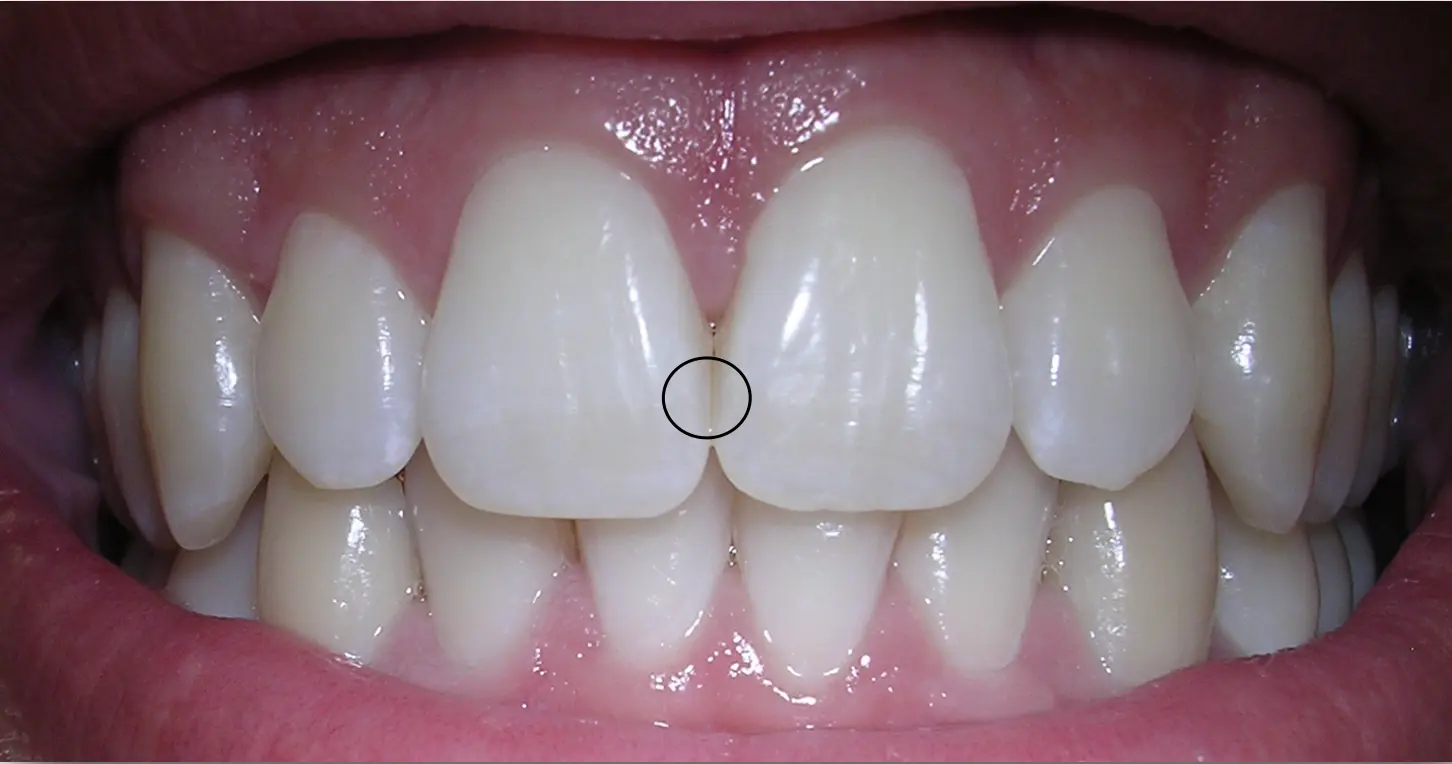
Proximal/Inter-proximal contact area (ICA) refers to the contact relation of one tooth with another in each arch. It can be defined as the zone in which two adjacent teeth appear to meet.
Except for the third molars (if present), each tooth is supported by its contact with two neighboring teeth, mesially and distally.
The term contact point is a misnomer, since, these are areas and not mere points of contact. In young individuals some of the newly erupted teeth may have point contacts only when the contacting surfaces are nearly perfect curvatures. e.g., Contacts located distally on canines and mesially on first premolars (maxillary and mandibular).
Identification & Location
The spaces that are formed coronal to the ICA are called spillway spaces or embrasures.
The spaces that are formed apical to the ICA are called interproximal spaces, that are usually filled with the interdental papilla.
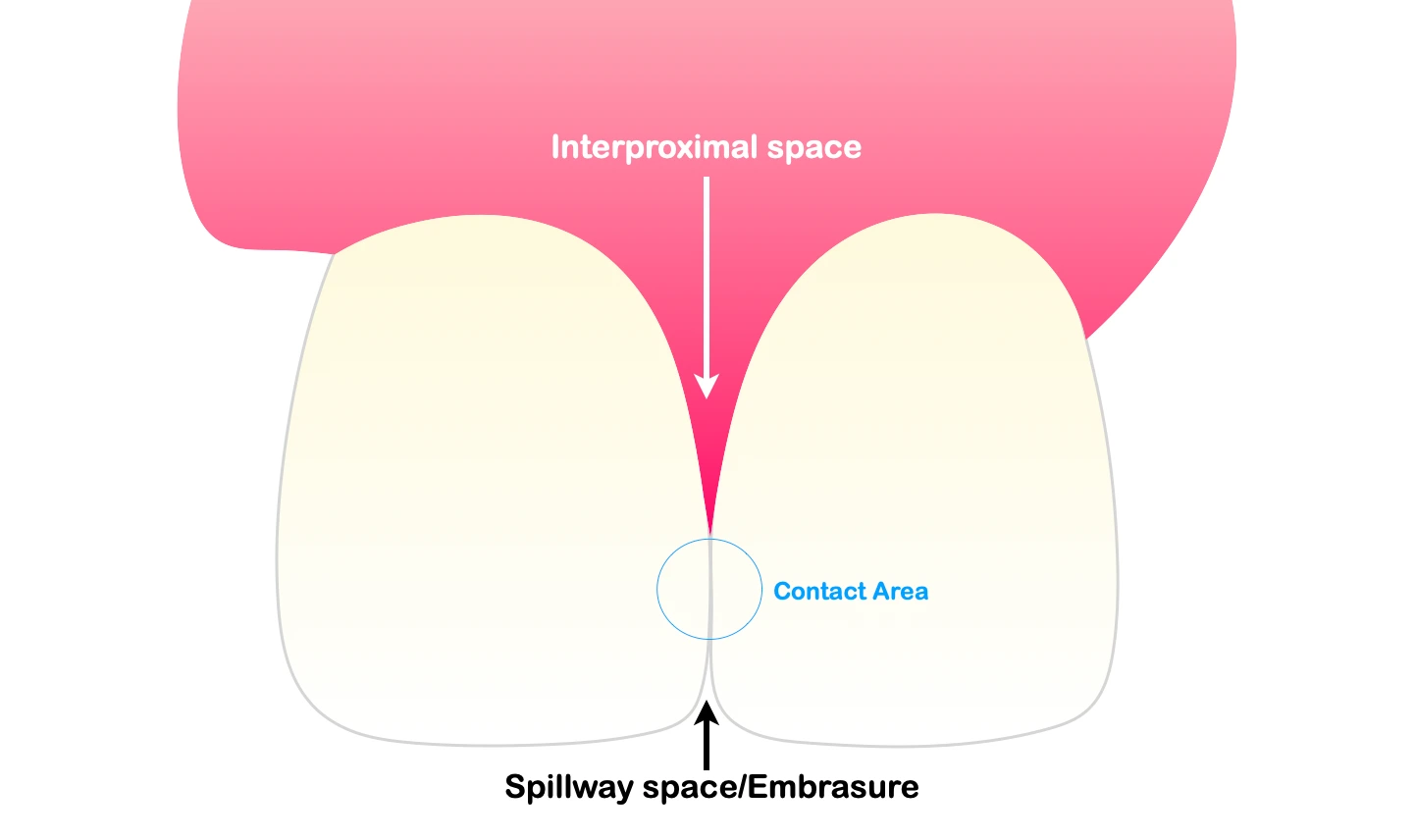
Contact areas can be located properly by observing them from two aspects: labial/buccal and incisal/occlusal.
Labial/Buccal View
- Shows the relative position of the contact areas cervico-incisally or cervico-occlusally.
- The center of the area from this aspect is gauged by its relation to the length of the crown portion of the tooth.
Incisal/Occlusal View
- Shows the relative position of the contact areas labiolingually or buccolingually.
- The center of the area can be located in its relation to the labiolingual or buccolingual measurement of the crown.
- The center point depends on the outline of the crown form from the incisal or occlusal aspect, which is governed by the alignment of the tooth in the arch and the occlusal relation with its antagonists in the opposing arch.
Significance
The gingival embrasure, the height of interdental papilla and the incisal/occlusal embrasure are all defined by the contact area. It is important to have proper contact relation between adjacent teeth in each arch because it helps to:
- Keep the food from packing between the teeth: If food is forced between the teeth past the contact areas, this may lead to inflammation of the interdental gingiva (gingivitis), involvement of deeper periodontal tissues and ultimately result in loss of bone and attachment (periodontitis).
- Stabilise the dental arches by combined anchorage of all the teeth: If the masticatory forces are not distributed properly, excessive occlusal forces may occur on an individual tooth.
- Ensure optimal ‘pink aesthetics’ for patients with a high smile line (or visible cervical margins): In anterior restoration, short contact area might result in black triangles, while high proximal contact area might impinge on the gum and cause unpleasant appearance.
*5 mm rule: When the distance from the contact point to the interproximal osseous crest is 5 mm or less, there would be a complete fill of the gingival embrasures with interdental papilla.
- Tarnow et al. recommended maintaining an interproximal contact distance of 4.5-5 mm from the upper margin of the alveolar crest to prevent the visibility of 'black triangles' in the frontal area, which in healthy periodontium is about 1.5-2 mm apical to cementoenamel junction.
- The chance of complete fill is progressively reduced by 50% for each millimeter increase above the 5 mm distance.
References
- Wheeler's Dental Anatomy, Physiology and Occlusion(2019), Stanley J. Nelson DDS MS, Elsevier.
- Sghaireen MG, Al-Zarea BK, Al-Shorman HM, Al-Omiri MK. Clinical measurement of the height of the interproximal contact area in maxillary anterior teeth. Int J Health Sci (Qassim). 2013 Nov;7(3):325-30. doi: 10.12816/0006061. PMID: 24533026; PMCID: PMC3921062.
- Image Credit: dozenist (Licensed under the Creative Commons Attribution-Share Alike 3.0 Unported license.).
*This article is excerpt from the above mentioned book and Medical Sutras does not make any ownership and affiliation claims.