
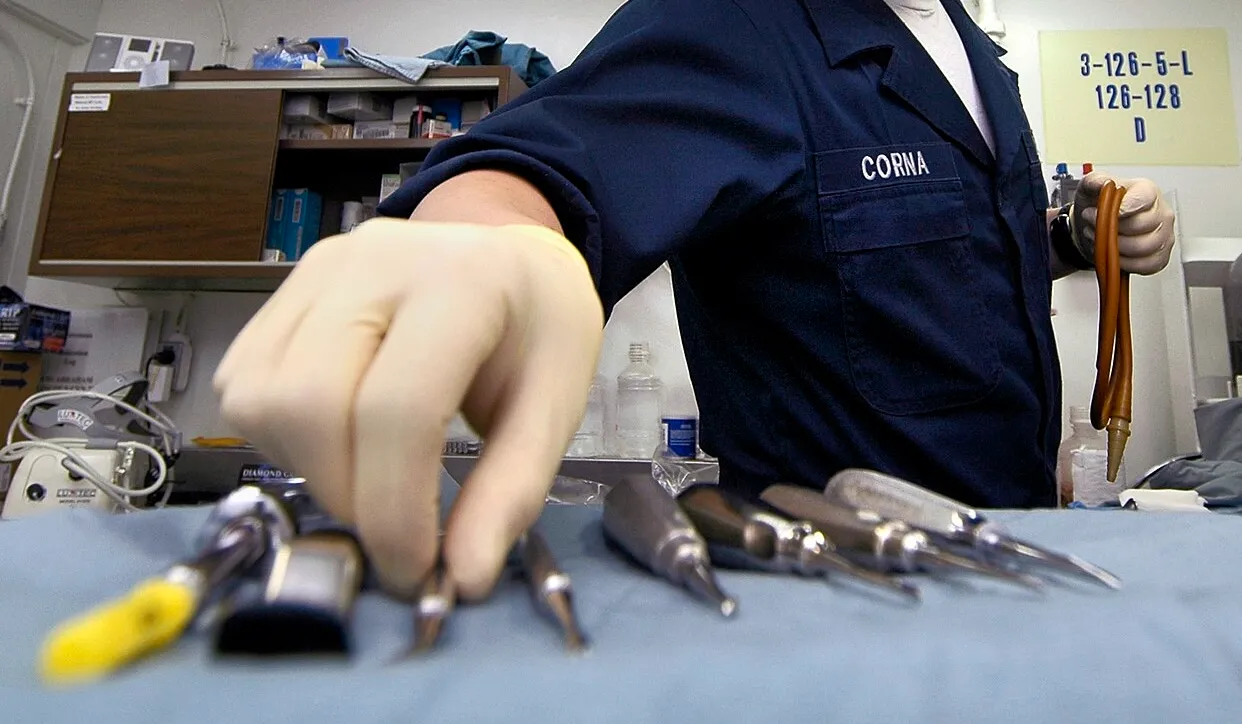
Instruments form the vital part of all routine procedures in oral and maxillofacial surgery such as incision of skin and mucosa, elevation of mucoperiosteum, soft tissue retraction, grasping soft tissue, controlling haemorrhage, removal of bone and soft tissue, suturing, etc.
The commonly used instruments in routine dental extractions and other basic oral surgical procedures are categorised as per their application.
Incising Tissue
Scalpel: Consist of reusable handle (Bard Parker handle) and disposable sharp blade (Bard Parker blade). Most commonly used handle is No. 3.
| Scalpel Blade | Use |
|---|---|
| 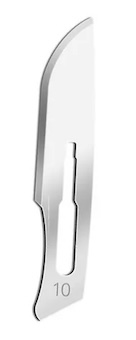 | No. 10: Large skin incisions in other parts of the body |
| 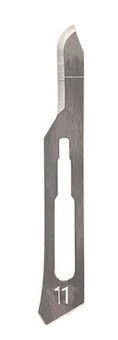 | No. 11: Small stab incisions such as for incision and abscess drainage |
| 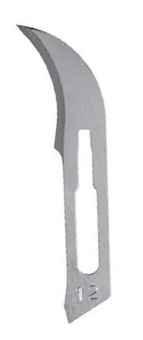 | No. 12: Mucogingival procedures in which incisions are made on the posterior aspects of teeth, or in the maxillary tuberosity area |
| 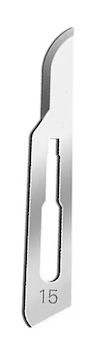 | No. 15: Incisions around teeth & through soft tissue (most commonly used blade for intra-oral surgery) |
Elevating the Mucoperiosteum
After incision, the periosteum needs to be reflected from the underlying bone in a single layer. The most commonly used periosteal elevator is,
No. 9 Molt Periosteal Elevator
- Consists of a sharp, pointed end and a broader rounded end.
- Pointed end: Used to begin the periosteal reflection and to reflect interdental papilla.
- Rounded end: Used to continue the elevation of the periosteum from bone.
Method
- Twisting, prying motion: Most commonly used when elevating the interdental papilla or the attached gingiva around a tooth to be extracted.
- Push stroke: Most efficient method, the pointed or broad end is slid underneath the periosteum.
- Pull stroke: Occasionally useful, tends to shred or tear the periosteum.
Soft Tissue Retraction
During oral surgical procedures, we need to retract the cheek, tongue, and mucoperiosteal flap.
Cheek
- Austin retractor (right-angle).
- Minnesota retractor (broad offset).
- Can be used to retract the cheek and mucoperiosteal flap simultaneously: Before the flap is created, it is held loosely in the cheek, and once the flap is reflected, the retractor edge is placed on the bone to retract the flap.
Mucoperiosteal Flap
- Seldin retractors: Similar to periosteal elevator, but the leading edge is smooth.
- No. 9 Molt periosteal elevator: The broad blade is used to retract the flap.
Tongue
- Mouth mirror: Most commonly used.
- Weider tongue retractor: Broad, heart-shaped retractor. It is serrated one side to engage the tongue firmly and retract it medially and anteriorly.
- Towel clip: Can be used certain cases such as when a biopsy is to be done on the posterior aspect of the tongue (tongue can be controlled by holding the anterior part with towel clip).
Grasping Soft Tissue
The soft tissue needs to be grasped in several surgical procedures so as to incise it, to stop bleeding or to pass a suture needle.
Adson Forceps (pickup)
- Most commonly used tissue forceps.
- May be with or without small teeth at the tips, to hold tissue gently and stabilise it.
- Should be used carefully, as holding a tissue too tightly can crush the tissue.
Stillies Forceps
- Longer forceps (7-9 inch) with a similar shape.
- Can be used to easily grasp tissue in the posterior part of the mouth.
College/Cotton Forceps (Cotton pliers)
- Angled forceps.
- Useful for picking up loose fragments of tooth, amalgam or other foreign material, or placing/removing gauze packs.
- Not much useful for handling tissue.
Allis Tissue Forceps
- Consist of teeth at the tip and locking handles.
- Locking handles provides firm grip, hence, useful for removing larger amounts of tissue or doing biopsies such as in epulis fissurata.
- It also allows the surgeon to place the forceps in proper position and then pass on to an assistant for holding and providing necessary tension for proper dissection of the tissue.
- Can be used for tongue retraction (similar to towel clamp).
- Should never be used on tissue that is to be left in the mouth, as they cause a relatively large amount of tissue destruction (crushing injury).
Controlling Hemorrhages
In most dentoalveolar surgery, pressure is sufficient to control bleeding at the site of incision. However, occasionally, pressure does not stop bleeding from a larger artery or vein. In such cases a hemostat is useful.
Hemostat
- Consists of long, delicate beaks to grasp tissue and a locking handle. The locking mechanism allows the surgeon to clamp the hemostat onto a vessel, useful when pressure on wound is not sufficient to control bleeding and when the surgeon plans to suture around the vessel or cauterise it.
- Also useful for removing granulation tissue from tooth sockets and to pick up small root tips, pieces of calculus, dental materials and any other small particles that have dropped into the wound or adjacent areas.
- Curved hemostat are commonly used.
Bone Removal
Rongeur Forceps
-
Most commonly used for removing bone in dental surgery.
-
Consists of sharp blades that can be squeezed together by the handles for cutting or pinching through bone, and a rebound mechanism that reopens the instrument when pressure is released.
-
Design types
- Side cutting forceps
- Side- and end-cutting forceps (Blumenthal rongeurs): More practical, as it can be inserted into sockets for removal of inter-radicular bone and also for removal of sharp edges of bone.
-
Small amounts of bone should be removed in multiple bites, and it should not be used to remove large amounts of bone in single bite.
Bur and Handpiece
- Handpiece: High-speed, high-torque handpieces.
- Burs: No. 557, No. 703 fissure bur, No. 8 round bur.
Mallet and Chisel
- Often used when removing lingual tori.
- Edge of the chisel must be kept sharp to function properly.
Bone File
- Double-ended instrument with a small and larger end.
- Used for final smoothing of bone after completing surgery.
- The teeth are mostly arranged to remove bone only with a pull stroke. Pushing action must be avoided, as this can result in burnishing and crushing of the bone.
Removing Soft Tissue from Bony Cavities
Periapical Curette
- Double-ended, spoon-shaped.
- Mainly used to remove granulomas or small cysts from periapical lesions.
- Can also be used to remove small amounts of granulation tissue debris from a tooth socket.
Suturing Soft Tissue
Needle Holder
- Consists of a locking handle and a short, blunt beak (shorter & stronger than the beaks of a hemostat).
- 6-inch needle holder is usually recommended for intraoral placement of sutures.
- Handling of the instrument: Thumb & ring finger are inserted through the rings and the index finger is held along the length of the needle holder.
Suture Needle
- Small half-circle or three eighths-circle suture needles are commonly used.
- It should be held at approximately 2/3rd of the distance between the tip and the base of the needle. This allows sufficient portion of the needle to pass through through the tissue while allowing the needle holder to grasp it in its strong position (to avoid bending).
Suture Materials
- Can be classified based on diameter, resorbability and as monofilament or polyfilament.
- 3-0 silk suture is most commonly used for oral surgical procedures. Size 3-0 has the appropriate amount of strength, while, the polyfilament nature of silk makes it easy to tie and well tolerated by soft tissues.
Dean Scissors
- Most commonly used suture scissors in oral surgery.
- Have slightly curved handles and serrated blades (makes cutting suture easier).
- Tissue scissors (Iris scissors & Metzenbaum scissors): Used for undermining of soft tissue and for cutting. These should not be used to cut sutures, since, the suture material can dull the edges of the blades, making them less effective and more traumatic when cutting tissue.
Holding the Mouth Open
Bite Blocks
- Soft, rubberlike block on which the patient can rest his/her teeth.
- Available in various sizes that produces varying degrees of opening and can be used to fit different patient sizes.
- Pediatric-sized bite block placed over the molars is adequate for most adult patients.
Side-action or Molt Mouth Prop
- Has a ratchet-type action, that opens the mouth wider as the handle is closed.
- Useful in patients who are in deep sedation or have mild forms of trismus.
- Must be used with caution, since, injudicious use may result in greater pressure on teeth and TMJ, resulting in injury.
Tooth Extraction
Dental Elevators
- Straight type: Most commonly used elevator to luxate teeth. e.g., No. 301 (small straight elevator), large straight elevators No. 34S, No. 46 and No. 77R.
- Triangular or pennant-shape type: Most useful when a broken root remains in the socket and the adjacent socket is empty. e.g., Cryer elevator.
- Pick type: Used to remove remove roots. e.g., Crane pick, Root-tip pick or apex elevator
Periotomes
- Used to extract teeth while preserving the anatomy of the tooth's socket (by severing some of the PDL).
- Periotome blade is inserted into the PDL space and advanced about 2-3 mm along the long axis of the tooth.
Extraction Forceps
- Used to remove the tooth from the socket.
- Are of different types based on the arch (maxillary & mandibular) and the type of teeth they are used for.
Other Instruments
Surgical suction
-
To remove blood, saliva ans irrigating solutions and provide adequate visualisation.
-
Fraser suction: Have a hole in the handle portion (can be covered with fingertip as needed).
- Cutting hard tissue under copious irrigation: Cover the hole for rapid suction.
- Soft tissue suction: Can be left uncovered to prevent tissue injury or soft tissue obstruction of the suction tip.
Towel clip: Holding towels & drapes in position.
Large plastic syringe with blunt needle: Irrigation
- While removing bone with handpiece and bur: Cools the bur and prevents bone-damaging heat buildup, and, increases efficiency of the bur by washing away bone chips from the flutes and providing lubrication.
- Clean the surgical field: During and after the surgical procedure.
References
- Contemporary Oral and Maxillofacial Surgery, 6 edition, James R. Hupp, Myron R. Tucker, Edward Ellis III, Mosby.
- The cover image is a work of a sailor or employee of the U.S. Navy, taken or made as part of that person's official duties. As a work of the U.S. federal government, it is in the public domain in the United States (Source: Wikimedia Commons).
*This article is an excerpt from the above mentioned book and Medical Sutras does not make any ownership or affiliation claims.