
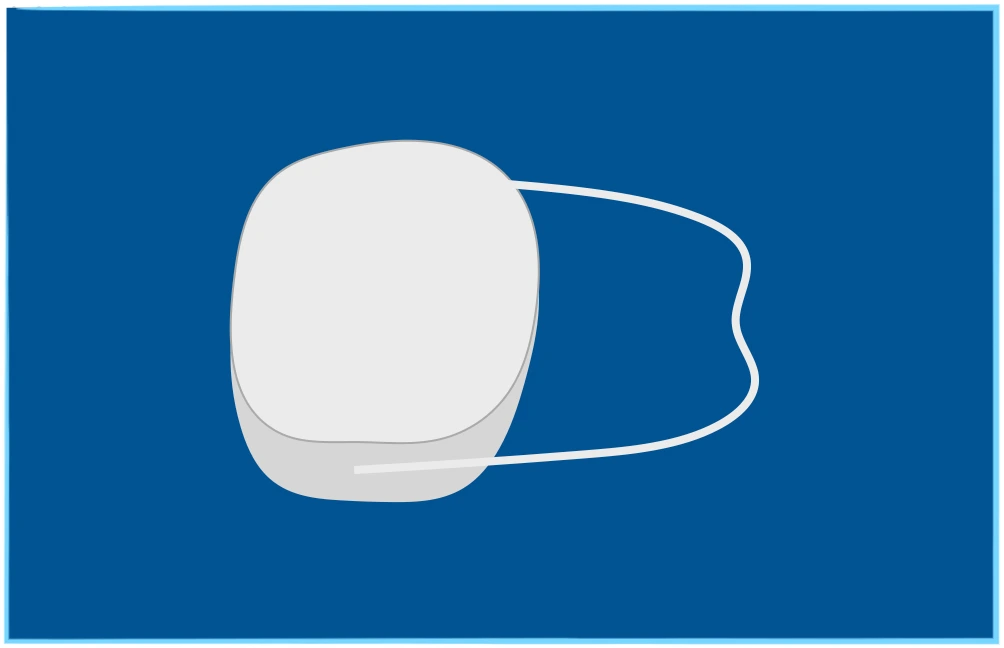
Band and loop is a unilateral fixed, non-functional, passive space maintainer.
It is indicated in case of:
- Premature loss of single maxillary or mandibular primary molars (unilateral or bilateral).
- Unerupted premolar is more than 2 years from clinical eruption and root length is less than one third or half mature.
*If a single primary molar has been lost bilaterally, before the eruption of permanent incisors, a pair of band and loop space maintainers is recommended instead of the lingual arch, because, as the permanent incisor tooth buds are lingual to the primary incisors, they often erupt lingually and the lingual wire may interfere with their eruption.
If necessary, the bilateral band and loops can be replaced with a single lingual arch later on.
Construction
Banding
- The band is fitted to the tooth posterior to the edentulous space, or the larger tooth.
- In case of loss of primary first molar --> Primary second molar is used and when primary second molar is lost, the band is fitted on permanent first molar.
- In case of loss of primary second --> Band can be placed on either the primary first molar, or the erupted permanent first molar.
- Sometimes, primary molar is preferred to permanent molar to prevent risk of decalcification of the permanent molar around the band. However, primary first molars are challenging to band because of their morphologic features, which converge occlusally and make band retention difficult.
- The primary first molar should not be banded, if the first premolar is developing more rapidly than the second premolar because the banded abutment tooth (i.e., primary first molar) will be lost earlier and this would require replacement of the appliance.
Impression
- After band adaptation, impression is made of quarter arch using alginate impression material with the band in place.
- This is followed by band removal from the patient's mouth using a band remover.
- The band is placed in the impression and stabilised in correct position using wax or piece of wire.
- Then, the impression is poured with the band in place.
Designing the wire loop
- The loop (0.036" wire) should be made parallel to the edentulous ridge, 1 mm off the gingival tissue and should rest against the adjacent tooth at the contact area.
- The facio-lingual dimension of the loop should be approximately 8 mm. This dimension would allow the permanent tooth/teeth to erupt freely and not impinge on the buccal mucosa or tongue.
- The distal free end of the loop should lie on both sides and in the middle of band. This allows occlusal clearance and adequate strength of the soldered joints.
Soldering the loop to band
- The loop is stabilised by placing plaster in the anterior region of the loop and the soldering is done using silver solder and flux. It is followed by quenching and acid treatment for 30 seconds.
Finishing and polishing
- The appliance is trimmed and polished followed by trial to see any impingement of band wire or solder and is cemented.
Modifications
- Crown and loop.
- Band and bar.
- Reverse band and loop.
- Band and loop appliance with occlusal rest.
Advantages
- Effective space maintainer for unilateral loss of single tooth in buccal segments.
- Construction is simpler and economical.
- Less chair-side time is required.
- Easily adjusted to accommodate the changing dentition.
Disadvantages
- Seldom used for space loss of more than one tooth.
- Non-functional .
- Migration of the loop gingivally (semi-fixed).
- Does not prevent continued or supra-eruption of opposing tooth.
- Passive appliance, can't be used where space has to be regained.
- Decalcification under bands may occur.
Contraindications
- An occlusion that is extremely crowded or already exhibits marked space loss.
- High dental caries activity.
- Cases that need guidance of eruption.
Points to Note
- Ideal for isolated unilateral space maintenance due to the simple cantilever design.
- The loop has limited strength and hence, the appliance must be restricted to holding the space of one tooth and is not expected to accept functional forces of chewing.
- It is no longer advisable to solder the loop portion to SS crown as this precludes simple appliance removal and replacement. Teeth with SS crowns should be banded like natural teeth.
- Survival of band and loop appliance is approximately 18 months, with cement failure cited as the most frequent problem.
References
- Textbook of Orthodontics (2nd Edition), Gurkeerat Singh, Jaypee Brothers Medical Publishers (P) Ltd.
- William R. Proffit- Contemporary Orthodontics (6th edition), Elsevier Mosby.
*This article is an excerpt from the above mentioned books and Medical Sutras does not make any ownership or affiliation claims.