
The classification system for malocclusion is an essential part in orthodontics as it serves several purposes :
- Devise proper information for diagnosis, presentation and treatment planning.
- Transfer data.
- Understand the problems associated with malocclusion.
- Comparison.
Methods for classification of malocclusion:
- Individual tooth malposition (Intra-arch malocclusion).
- Interarch malocclusion (Malrelation of dental arches).
- Angle’s Classification.
- Dewey’s modification of Angle’s classification.
- Lischer’s modification of Angle’s classification.
- Bennet’s classification (Based on etiology).
- Simon’s classification (In relation to the three planes of space).
- Salzmann (Skeletal classification).
- Ackerman-Proffit system.
- Incisor classification (British Standards Institute Glossary of Dental Terms).
Angle’s Classification
Edward Hartley Angle in the year 1899 came up with the classification of malocclusion, that proved as an important step in the development of orthodontics because it not only subdivided major types of malocclusion but also included the first clear and simple definition of normal occlusion in the natural dentition.
- With the establishment of a concept of normal occlusion and a classification scheme that incorporated the line of occlusion, by the early 1900s orthodontics was no longer just the alignment of irregular teeth. Instead, it had evolved into the treatment of malocclusion, defined as any deviation from the ideal occlusal scheme described by Angle.
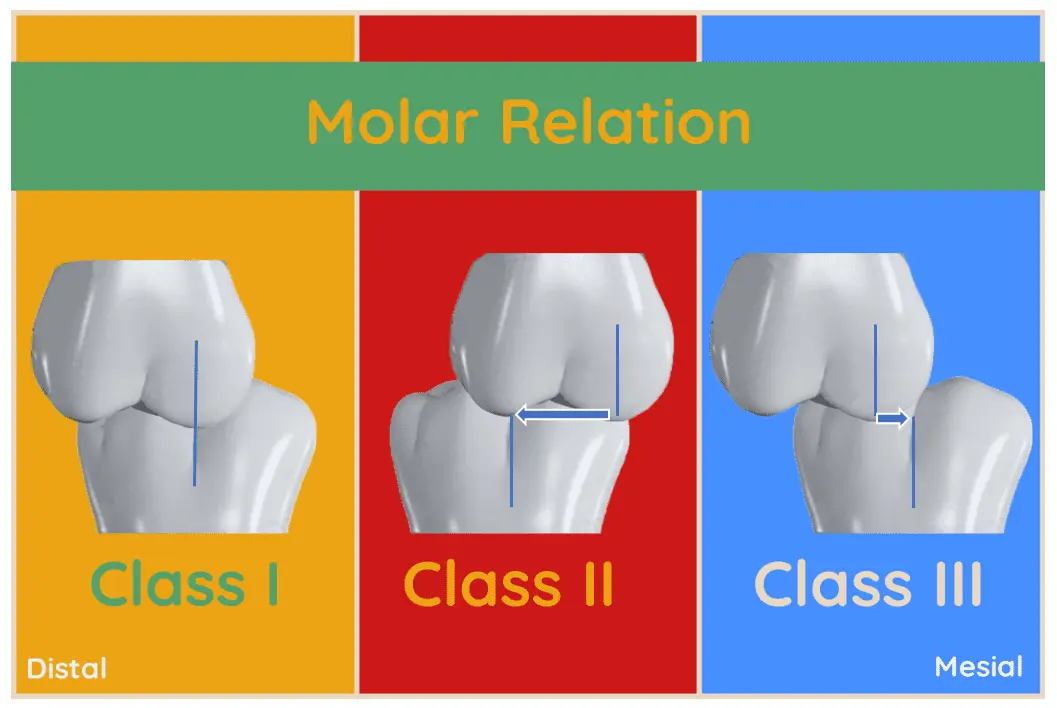
- Angle’s postulate was that the upper first molars were the key to occlusion and that the upper and lower molars should be related so that the mesiobuccal cusp of the upper first permanent molar occludes in the buccal groove of the lower first permanent molar.
- The basis of the Angle classification was the relationship of the first molar teeth and the alignment (or lack of it) of the teeth relative to the line of occlusion.
Normal Occlusion
- Class I molar relation i.e. the mesiobuccal cusp of the upper first permanent molar occludes in the buccal (mid-buccal/mesiobuccal) groove of the lower first permanent molar.
- The teeth are arranged on a smoothly curving line of occlusion.
Class I Malocclusion
- Normal relationship of the molars (Class I).
- The mesiobuccal cusp of the upper first permanent molar lies on or, coincides with the mesiobuccal groove of the lower first permanent molar.
- Line of occlusion incorrect because of malposed teeth, rotations, or other causes.
Class II Malocclusion
- Lower molar distally positioned relative to upper molar, i.e. the lower first molars occlude distal to the Class I position.
- The mesiobuccal cusp of the upper first permanent molar is mesial to the mesiobuccal groove of the lower first permanent molar.
- Line of occlusion not specified, it may or may not be correct.
Divisions: Class II malocclusion is further divided in Division I and Division II based on the inclination of upper incisors.
-
Class II Division I
- Characterized by protruding maxillary incisors.
- The individual generally presents with a convex profile, increased overjet and lip trapping.
-
Class II Division II
- Lingual inclination of maxillary central incisors and proclination of maxillary lateral incisors (tipped labially and/or mesially).
- There is reduced overjet (almost Nil), square-shaped arch, deep bite and a flat profile.
- Very difficult to treat as during early days, the profile is normal and patient presents at a very late stage; it is difficult to treat after 15 years of age and there are high chances of relapse.
Class III Malocclusion
- Lower molar mesially positioned relative to upper molar, i.e. the mandibular first molars occlude mesial to Class I position (the mesiobuccal cusp of the upper first permanent molar is distal to the mesiobuccal groove of the lower first permanent molar).
- Line of occlusion not specified, it may or may not be correct.
- Common feature include edge to edge bite or cross-bite of anterior teeth.
*Pseudo Class III Malocclusion: This is not a true Class III malocclusion but the presentation is similar. Here the mandible shifts anteriorly in the glenoid fossa due to a premature contact of the teeth or some other reason when the jaws are brought together in centric occlusion.
*Subdivision: The term is used when the malocclusion is unilateral i.e., one side of arch is normal and the other side shows malocclusion.
Drawbacks of Angle’s Classification
- According to Angle, since maxilla is attached to the cranium, the upper arch and hence, the maxillary molars are fixed. Any change occurring is due to mandibular molars which is not always the case.
- Angle classified malocclusion only in the anteroposterior plane.
- The classification is based on molar relationship, hence can’t be done in the absence of permanent 1st molar.
- Not valid in deciduous dentition and mixed dentition, even if a single deciduous tooth is present.
- Does not account for skeletal defects.
- Individual tooth malocclusions have not been considered.
Points to Note
-
Because precisely defined relationships required a full complement of teeth in both arches, maintaining an intact dentition became an important goal of orthodontic treatment. Angle and his followers strongly opposed extraction for orthodontic purposes.
-
* Under the leadership of Charles Tweed in the United States and Raymond Begg in Australia (both of whom had studied with Angle), extraction of teeth was reintroduced into orthodontics in the 1940s and 1950s to enhance facial esthetics and achieve better stability of the occlusal relationships.
-
With the emphasis on dental occlusion that followed Angle’s classification, less attention came to be paid to facial proportions and esthetics. Angle abandoned extraoral force because he decided this was not necessary to achieve proper occlusal relationships. He solved the problem of dental and facial appearance by simply postulating that the best esthetics always were achieved when the patient had ideal occlusion.
-
In the 1960s, Ackerman and Proffit formalized the system of informal additions to the Angle method by identifying five major characteristics of malocclusion to be considered and systematically described in classification. The approach overcame the major weaknesses of the Angle scheme.
- Dentofacial appearance (Asymmetric, Symmetric).
- Teeth/Arch form (Alignment, Symmetry).
- Transverse relationship (Wide, Narrow).
- Sagittal/ A-P relationship (Class II, Class III).
- Vertical relationship (Deep bite, Open bite).
References
- Proffit, William R. - Contemporary Orthodontics - Elsevier Mosby (2018).
- Textbook of Orthodontics (2nd Edition), Gurkeerat Singh, Jaypee Brothers Medical Publishers (P) Ltd.
- M. T. Cobourne, P. S. Fleming, A. T. DiBiase, S. Ahmad Clinical Cases in Orthodontics.
*This article is an excerpt from the above mentioned books and Medical Sutras does not make any ownership or affiliation claims.