
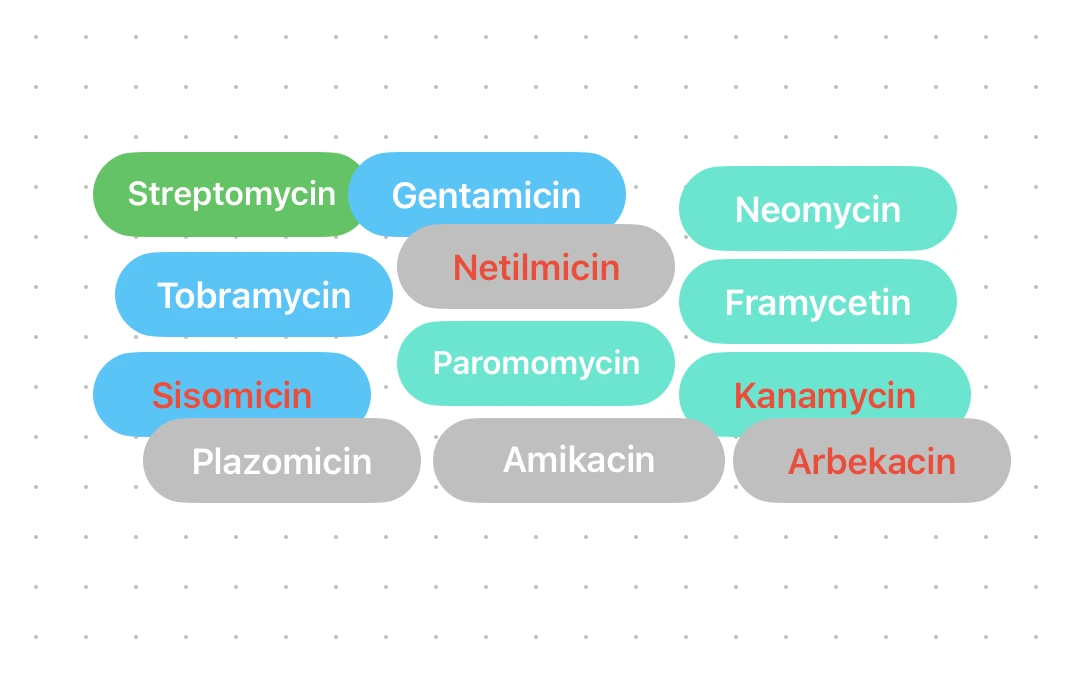
Aminoglycosides consist of two or more amino sugars attached to a hexose ring, either streptidine (in streptomycin) or 2-deoxystreptamine (in other aminoglycosides) by glycosidic linkage.
Mechanism of Action
Aminoglycosides are bactericidal agents, that inhibit protein synthesis irreversibly and are active against aerobic gram-negative bacilli.
-
Aminoglycosides enters the periplasmic space by passive diffusion (driven by the negative interior membrane electrical potential) via porin channels in the outer membrane of gram-negative bacteria.
-
Entry from the periplasmic space across the cell membrane is through active transport by an oxygen-dependent process (energy dependent phase I or EDP1 entry).
*Anaerobic conditions : The oxygen-dependent active transport does not occur, and hence anaerobic bacteria are resistant.
-
Once inside the cell, streptomycin binds to 30S subunit, while other aminoglycosides bind to additional sites on 50S subunit and 30S-50S interface. They inhibit protein synthesis in several ways:
- Interference with the initiation of protein synthesis by fixing the 30S-50S ribosomal complex at the start codon (AUG) of mRNA.
- Misreading of mRNA template, leading to incorporation of incorrect amino acids into the peptide and formation of a nonfunctional protein.
- Breakup of polysomes into nonfunctional monosomes (mRNA chain with only a single ribosome).
-
Secondary changes : There is incorporation of defective proteins into the cell membrane, leading to alteration in the integrity of cell membrane and increased permeability. This results in augmentation of the carrier-mediated energy-dependent phase II entry of the antibiotic and leakage of amino acids and proteins, leading to cell death.
Mechanism of Resistance
- Production of cell membrane bound modifying enzymes that adenylate, acetylate or phosphorylate aminoglycosides and prevents them from binding to ribosomes.
- Mutation or deletion of porin protein involved in the transport and maintenance of the electrochemical gradient, thus impairing the entry of aminoglycosides into the cell.
- Mutation or deletion of receptor protein on the 30S ribosome, decreasing the affinity of the ribosomal proteins.
Pharmacokinetics
Absorption
- Highly polar (ionised), poorly absorbed from the g.i. tract.
- Rapidly absorbed after intramuscular injection.
Distribution
- Distributed only extracellularly, do not penetrate into most cells, CNS and the eye.
- Volume of distribution (~0.3 L/kg) is nearly equal to the volume of extracellular fluid.
- High concentrations are found in the renal cortex and the inner ear (endolymph), likely contributing to nephrotoxicity and ototoxicity.
- Cross placenta and accumulate in fetal plasma and amniotic fluid : Can cause hearing loss in children, if administered during pregnancy.
Elimination
- Aminoglycosides are not metabolised in the body and are excreted almost entirely by glomerular filtration.
- Plasma half-lives : 2-4 hours, in patients with normal renal functions.
- A linear relationship exists between serum creatinine and the half life of all aminoglycosides and the dosage needs to adjusted in patients with renal insufficiency.
Dosage
-
For an average adult with normal renal function (Creatinine clearance more than 70 ml/min):
- Gentamicin, Tobramycin : 3-5 mg/kg/day (Max 5.5 mg/kg).
- Streptomycin, Kanamycin, Amikacin : 7.5-15 mg/kg/day (Max 15 mg/kg).
-
The dosage must be adjusted for patients with creatinine clearance less than 80-100 ml/min.
-
Single daily dosing : Recommended in patients with normal renal function, since,
- Aminoglycosides exhibit concentration-dependent killing, i.e, higher concentrations kill more bacteria and at a more rapid rate.
- Exhibit a long post-antibiotic effect.
- Plasma concentration remains sub-threshold for ototoxicity and nephrotoxicity for longer period.
- Better efficacy, lower cost and easier administration.
- Concentrations of less than 1 mcg/ml should be present between 18 and 24 hours after dosing.
-
Twice or thrice daily dosing : Recommended in patients with renal insufficiency, in pregnancy, neonatal and pediatric infections and when given as low-dose combination therapy for bacterial endocarditis.
- Gentamicin and Tobramycin : Dosage is adjusted to maintain peak levels between 5 and 10 mcg/ml (Serious infections : 8-10 mcg/ml) and trough levels less than 2 mcg/ml (Optimal : Less than 1 mcg/ml)
-
Every 48 hour dosing : Patients with creatinine clearance less than 20-25 ml/min.
Indications
Aminoglycosides are mostly used in combination with other antibiotics for the treatment of aerobic gram-negative infections, esp. drug-resistant cases.
Streptomycin
- Mainly used as a second line treatment in tuberculosis (given in combination with other agents to prevent resistance) : 15 mg/kg/d with a maximum of 1 g/d, IM or IV (20-40 mg/kg/d for children).
- Plague, Tularemia and Brucellosis (sometimes) (in combination with oral tetracycline) : 1 g twice daily, IM (15 mg/kg twice daily for children) for 7-10 days.
- Gentamicin-resistant bacterial endocarditis, in patients who cannot tolerate a less toxic alternative.
Gentamicin
- Mainly used in severe infections caused by gram-negative bacteria that are resistant to other drugs, esp. Pseudomonas aeruginosa, Enterobacter sp., Serratia marcescens, Proteus sp., and Klebsiella sp. : 5-7 mg/kg/d IV in three equal doses or once daily.
- Endocarditis caused by gram-positive bacteria (Streptococci, Staphylococci and Enterococci) : In combination with a cell wall-active antibiotic such as beta-lactams.
- Peritoneal dialysis-associated peritonitis.
- Topical administration (0.1-0.3 %) : Treatment of infected burns, wounds or skin lesions and in attempts to prevent IV catheter infections.
- Intrathecal administration (1-10 mg/d): Meningitis caused by gram-negative bacteria, in cases of drug-resistant or treatment-refractory meningitis or severe beta-lactam allergy.
Tobramycin
- Almost similar to gentamicin in pharmacokinetics, anti-bacterial spectrum and toxicity.
- Can be used interchangeably with gentamicin : 5-7 mg/kg IM or IV, given into three equal doses or as a single dose.
- Preferred for treatment of infections caused by Pseudomonas, in conjuction with and antipseudomonal beta-lactam antibiotic. *(*Tobramycin is slightly more active against P aeruginosa.)
- Inhaled administration (300 mg in 5ml) : Treatment of P aeruginosa lower respiratory tract infections complicating cystic fibrosis.
- Ophthalmic administration (0.3 % ophthalmic oint) : Treatment of superficial eye infections.
Amikacin
- Resistant to many enzymes that inactivate gentamicin and tobramycin : Specially useful in serious nosocomial gram-negative bacillary infections resistant to gentamicin and tobramycin (15 mg/kg/day as a single or multiple dose).
- Multidrug-resistant Mycobacterium tuberculosis, including Streptomycin-resistant strains : 10-15 mg/kg/d as once-daily or twice-or thrice-weekly injection, always in combination with other drugs.
Neomycin
-
Broad spectrum aminoglycoside.
- Gram-negative : E. coli, Enterobacter aerogens, Klebsiella pneumoniae and Proteus vulgaris.
- Gram-positive : S. aureus and E. faecalis.
- M. tuberculosis.
-
Usage of neomycin is generally limited to topical and oral route, due to toxicity associated with parenteral use and higher resistance rates compared to other aminoglycosides.
-
Topical administration (1-5 mg/ml solution, Max dose - 15 mg/kg/d) : Used on infected surfaces (burns, wounds, ulcers, etc.) or injected into joints, pleural cavity, tissue spaces or abscess cavities where infection is present.
-
Oral administration (1 g every 6-8 hrs for 1-2 days): In preparation of bowel before surgery, combined with 1 g of erythromycin base.
Paromomycin
- Shown to be effective against many protozoan parasites including E. histolytica, Giardia lamblia, Trichomonas vaginalis, Cryptosporidium and Leishmania.
- Can be used for cutaneous leishmaniasis and parenterally for visceral leishmaniasis.
- Intestinal Entamoeba histolytica infection and sometimes for intestinal infections with other parasites.
Adverse Effects
Ototoxicity (Vestibular and Cochlear toxicity)
- Aminoglycosides accumulate in the inner ear and as the plasma drug concentrations are persistently elevated, there is progressive destruction of the vestibular or cochlear sensory cells.
- Neomycin, kanamycin and amikacin are most likely to cause hearing loss, while streptomycin and gentamicin are more vestibulotoxic.
- Cochlear toxicity : There is high-pitched tinnitus that can persist for days or weeks, followed by auditory impairment.
- Vestibular toxicity : There is headache, followed by nausea, vomiting and difficulty with balance (develops acutely and persists for 1-2 weeks). This is followed by chronic labyrinthitis that presents with difficulty when trying to walk or make sudden movements and persists for ~2 months.
Nephrotoxicity
- There is mild renal impairment in approximately 8-26% of patients.
- Almost always reversible, as the proximal tubular cells can regenerate.
- There is excretion of enzymes of the renal tubular brush border, followed by a defect in renal concentrating ability, mild proteinuria, and the appearance of hyaline and granular casts.
- Most nephrotoxic : Neomycin, Gentamicin and Tobramycin.
- The toxicity may be increased with administration of drugs such as Amphotericin B, Vancomycin, ACE inhibitors, Cisplatin, and Cyclosporine.
Effects on the nervous system
-
Acute neuromuscular blockade and apnea :
- A curare-like effect with neuromuscular blockade, resulting in respiratory paralysis.
- Seen after intrapleural or intraperitoneal instillation of large doses.
- Can be reversed with calcium gluconate or neostigmine.
-
Dysfunction of the optic nerve, including scotomas (seen with Streptomycin).
Points to Note
- Several types of infections can be treated successfully with aminoglycosides, however, owing to their toxicities, prolonged use should be restricted to life threatening infections and in cases where other less toxic agents are contraindicated.
- Gentamicin is the most commonly used and first line aminoglycoside.
- Aminoglycosides should not be administered during pregnancy, until there is no other suitable alternatives.
- Aminoglycosides should not be administered with other nephrotoxic and ototoxic drugs.
- Aminoglycosides should not be mixed with any other drug in the same syringe or infusion bottle.
References
- Essentials of Medical Pharmacology (8th Edition), K. D. Tripathi, Jaypee Brothers Medical Publishers (P) Ltd.
- Basic and Clinical Pharmacology (15th Edition), Bertram G. Katzung, Todd W. Vanderah, McGraw Hill Lange.
- Goodman and Gillman's Manual of Pharmacology and Therapeutics, McGraw Hill Medical.
*This is an excerpt from the above mentioned books and Medical Sutras does not make any ownership and affiliation claims.