
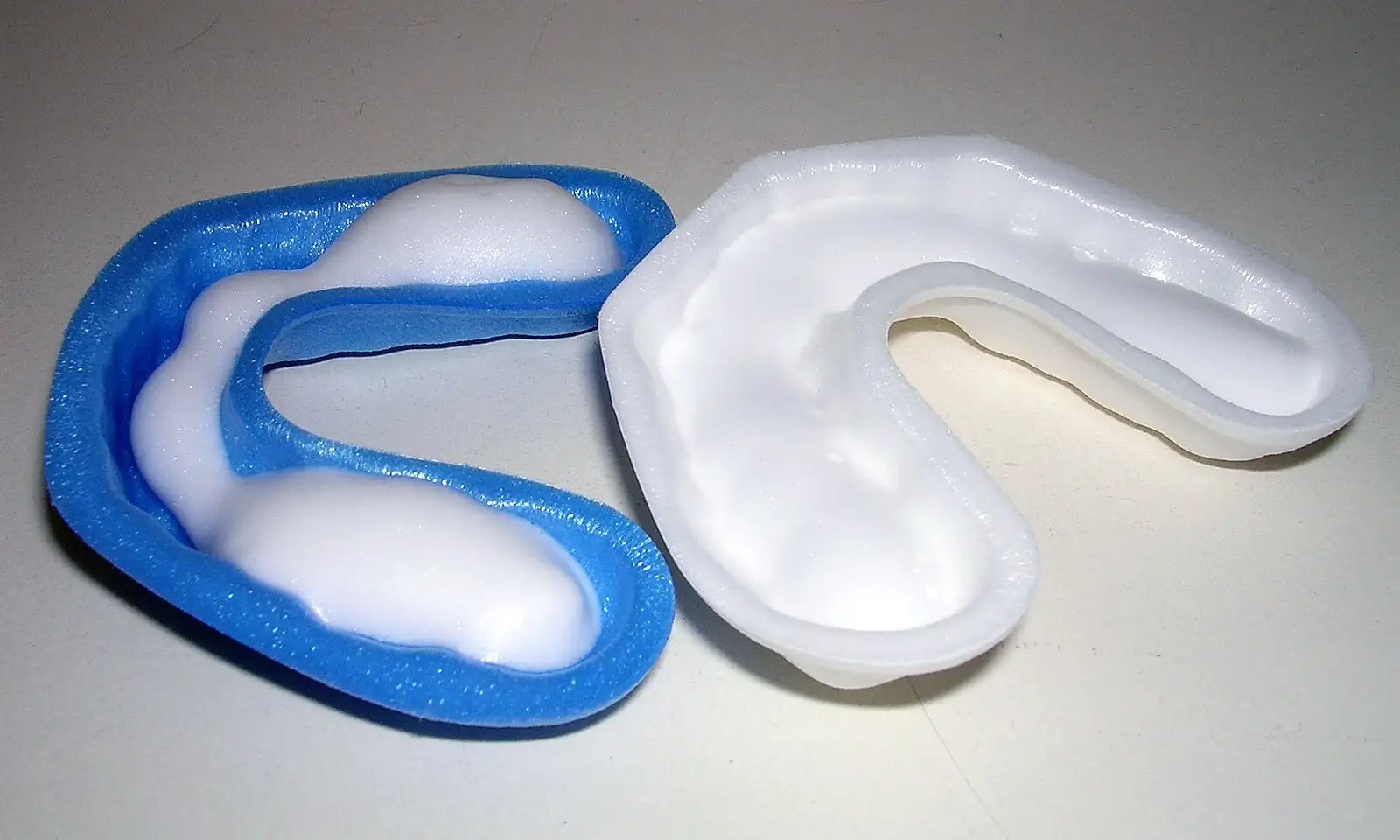
Acidulated phosphate fluoride (APF) introduced by Budevold and co-workers in 1960, is composed of 1.23% sodium fluoride (NaF) buffered to a pH of 3-4 using 0.1M phosphoric acid.
It was developed in order to achieve greater amounts of fluoridated hydroxyapatite (FHA) and less of calcium fluoride (CaF2).
Mechanism of Action
Initially, APF leads to dehydration and shrinkage in the volume of hydroxyapatite crystals. This is followed by further hydrolysis and formation dicalcium phosphate dihydrate (DCPD).
Ca10(PO4)6 + NaF -> CaHPO4.2H2O
DCPD is highly reactive and the fluoride ions start penetrating into the deeper crystalline structure of enamel forming fluorapatite, which is stronger to acid dissolution.
CaHPO4.2H2O + F -> Ca(PO4)3F + HPO4
Preparation
APF is available both as solution and gel. The development was based on the fact that slightly demineralised enamel will acquire more fluoride than unaffected enamel.
- The APF solution is prepared by dissolving 20 gm of sodium fluoride in 1 L of 0.1 M phosphoric acid, followed by addition of 50% hydrofluoric acid to maintain a pH of 3.0 and fluoride ion concentration at 1.23% percent.
- For preparation of APF gel, a gelling agent such as methylcellulose or hydroxyethyl cellulose is added to the solution and the pH is adjusted around 4-5.
Application
The recommended frequency of application is twice a year.
APF Solution
- Oral prophylaxis is done.
- Teeth are isolated with cotton rolls and dried with compressed air.
- APF solution is applied continuously with cotton applicator, to keep teeth moist for 4 minutes.
- After the solution is applied to all the teeth, patient is asked to expectorate and instructed not to rinse, drink or eat for next half hour.
APF Gel
- Disposable mouth trays are selected and necessary adjustments are done to properly adapt the trays.
- Patient should be seated upright and suction should be used during the procedure.
- Teeth are air-dried before gel application.
- The gel used should be enough to completely cover the teeth, but not more than 2-2.5 gm/tray or 40% of the tray capacity.
- Upper and lower trays are to be inserted separately and fluoride should be applied for 4 minutes.
- Patient is asked to expectorate for 1-2 minutes after tray removal.
- Patient is instructed not to rinse, eat or drink for at least 30 minutes.
*For patients with porcelain or resin restorations, neutral sodium fluoride is recommended to prevent etching of restorations.
Advantages
- Expected caries reduction is about 30-40% better than sodium fluoride and stannous fluoride.
- Half-yearly or annual application.
- Chemically stable and can be stored in plastic container for ready use.
- No staining of teeth.
- Available with different flavouring agents.
- Can be self-applied and recommended for home use.
Disadvantages
- Cannot be stored in glass container, as it may etch and remove minerals from the glass.
- Repeated exposure of porcelain or composite restorations can lead to loss of mineral leading to surface roughening and cosmetic changes.
- It has an acidic taste.
- Repeated application necessitates the use of suction, limiting its use in field programs.
References
- C. M. Marya - A Textbook of Public Health Dentistry, Jaypee Brothers Medical Publishers (P) Ltd (2011). https://amzn.to/3SHP36G
- S. S. Hiremath - Textbook of Public Health Dentistry, Elsevier India (2016). https://amzn.to/49mh2jw
- The image used is licensed under the Creative Commons Attribution-Share Alike 3.0 Unported license. Source: Wikimedia Commons (Picture taken at the University of TN Dental School in Memphis, TN of a maxillary and mandibular tray with fluoride. Taken on July 05, 2005 by Dozenist).
*This article is an excerpt from the above mentioned books and Medical Sutras does not make any ownership and affiliation claims.