Microbiology is the study of microorganisms such as bacteria, fungi, viruses, protozoa and algae.
Microorganisms are very minute organisms that are too small to be seen with the naked eye.
Early Developments
Spontaneous generation : According to Aristotle (384-322 BC), it was "readily observable that aphids arise from the dew which falls on plants, fleas from putrid matter, mice from dirty hay".
Francesco Redi (1668) : First to formally challenge the accepted belief of spontaneous generation. In his experiment, Redi put meat into three separate jars.
Louis Jablot (1670) : Conducted an experiment in which he divided a hay infusion that had been boiled into two containers:
- One that was closed to air.
- Another that was freely open to air.
- Only the open container showed microbial growth. This helped disprove abiogenesis.
Antonie Philips Van Leeuwenhoek (Dutch Draper)
- Discovered microscope.
- He called these tiny living organisms "animalcules".
Sedillot (1878) : Used the term "microbe".
Louis Pasteur (1822-1895)
French chemist, regarded as the Father of Microbiology.
- Coined the term "Microbiology".
- Disproved spontaneous generation.
- Germ theory of disease.
- Demonstrated that anthrax was caused by bacteria.
- Developed effective vaccines (Rabies, Anthrax).
- Invented processes of Pasteurisation, Fermentation.
- Demonstrated diseases of silkworm were due to protozoan parasite.
Theory of Biogenesis : Living cells arise from preexisting living cells.
- Broth sterilised, trapped air escapes from open end of flask.
- Broth allowed to cool slowly, bacteria and dust from air settle in bend.
- Broth stays sterile indefinitely.
- Flask tilted so that the sterile broth comes in contact with bacteria and dust from air.
- After hours/days, bacteria seen multiplying in the broth.
Joseph Lister (1827-1912)
- British surgeon, regarded as the Father of Antiseptic Surgery.
- In 1867, Lister applied Germ theory to medical procedures.
- He noticed that many patients would die following surgery, not from the original problem but from infection following the surgery.
- He treated surgical wounds with phenol (carbolic acid).
- Many lives were saved once this procedure was adopted.
Robert Koch (1843-1910)
-
German physician, regarded as the Father of Bacteriology.
-
Role of bacteria in causing disease.
-
Perfected the technique of isolating bacteria in pure culture.
-
Described Hanging drop method.
-
Discovered Anthrax bacillus, Tubercle bacillus and Cholera bacilli.
-
With his assistant Ehrlich (who worked on dyes), they were able to stain bacteria and viewed them on microscope.
-
Koch's Postulates : Microorganisms can be accepted as the causative agent of an infectious disease only if the following conditions are fulfilled
- The same microorganisms are present in every case of the disease.
- It should be possible to isolate the microorganism in its pure culture from the tissues of dead animal or lesion of the disease.
- The isolated microorganisms from the pure culture when introduced into a healthy, susceptible animal, should reproduce the same disease.
- It should be possible to re-isolate and re-cultivate the identical microorganism from the tissue specimens of the experimental animal.
- Infection should produce circulating antibody specific for the infecting microorganism.
-
Robert Koch used gelatin to prepare solid media: Not ideal, since being a protein, it is digested by many bacteria that are capable of producing a proteolytic exoenzyme gelatinase that hydrolyses the protein to amino acids.
-
Koch's assistant's wife Fanny Hesse (born Angelina Fanny Eilshemius) proposed the use of agar in culture media.
- It was not attacked by most bacteria.
- Better than gelatin because of its higher melting point (96o C) and solidifying point (40-45o C).
Paul Ehrlich (1854-1915)
- Known as the Father of Chemotherapy.
- Speculated about some "magic bullet" that would selectively find and destroy pathogens but not harm the host (selective toxicity).
- In 1890s, proposed a theory of immunity in which antibodies were responsible for immunity (antitoxin).
- Also developed a staining procedure to identify tubercle bacilli.
Evolution of Vaccine
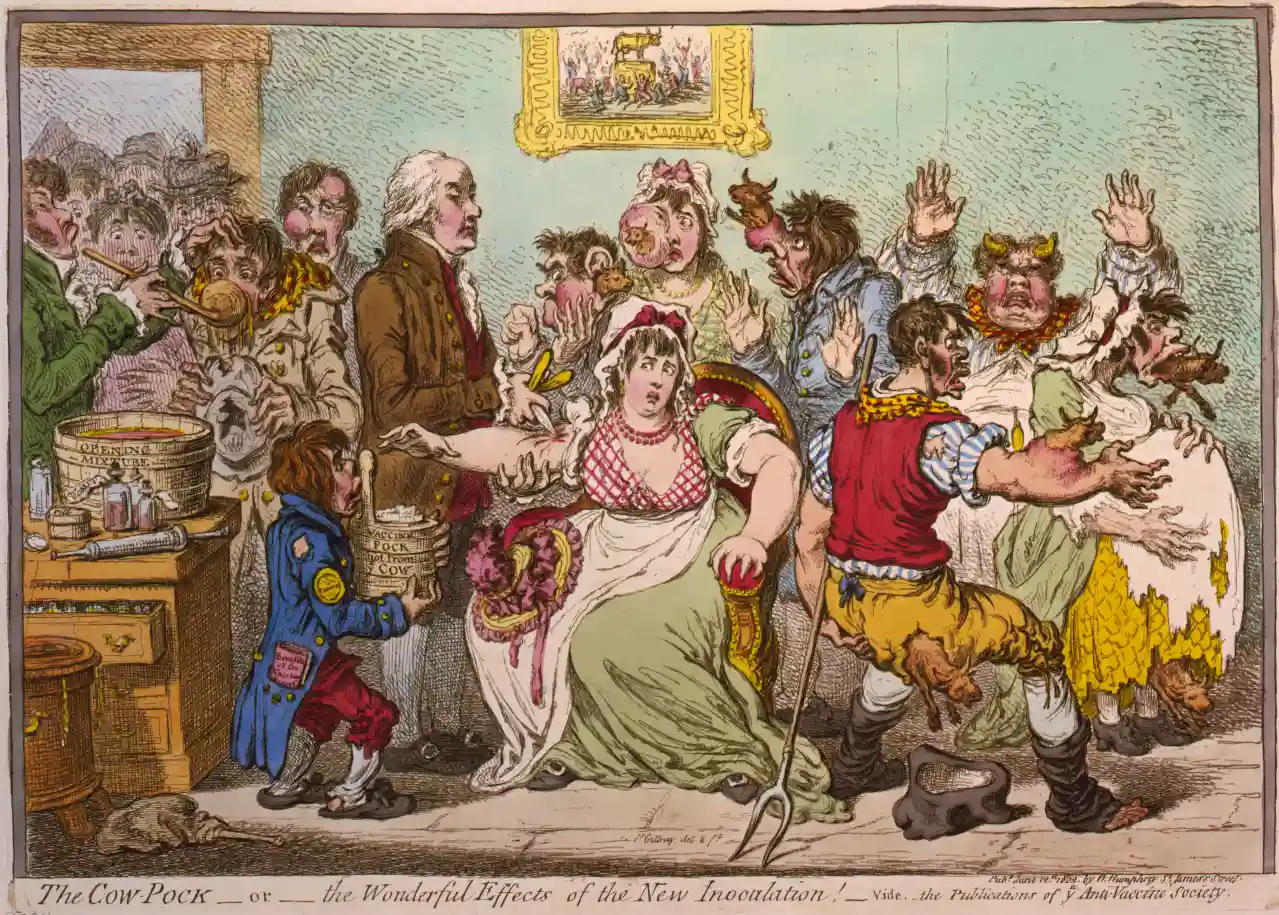
Edward Jenner (1796)
- British physician, first provide the concept of vaccination.
- Edward Jenner was informed by a milkmaid that she couldn't get smallpox because she was exposed to cowpox by working around cows.
- Jenner experimented using scrapings from cowpox blisters.
- He found that the child infected with cowpox was immune to smallpox when injected with smallpox. The procedure was called vaccination (vacca, Latin word meaning cow).
Pasteur's Attenuated Vaccines
- Pasteur noticed that the organism that causes fowl cholera lost ability to cause disease after grown in lab for long periods.
- Pasteur was experimenting with fowls and fowl cholera. He started with a very virulent strain of the disease. Each time he would inject a new bird with the organism it would die. Over time he noticed that the birds began to live in spite of the injections with the disease.
- Then, he noticed that when he injected them again with a fresh new strain, they still didn't get sick.
- Pasteur concluded that the strain that had been grown in the lab for a long period of time was still able to cause an immune response, but it was not strong enough to make the bird sick. Thus, the animals became immune to the disease.
Discovery of Penicillin
Sulfa drugs were the first type of medicine prescribed for infections, made from dyes used from fabrics.
- Alexander Fleming was conducting experiments with bacteria on agar plates. In the process of one experiment he discovered that his plates had been contaminated with mold (Penicillium notatum). He threw those plates in the trash.
- Then, he started to think about what he had seen on those plates and retrieved them from the trash can. He noticed that all around the mold was an area where bacteria was not growing. It occurred to him that the mold would be killing the bacteria.
- That's how penicillin was discovered.
- Many antibiotics that we use today are made by other organisms.
Discovery of Important Organisms
- Ogston : Staphylococcus aureus.
- Neisser : Neisseria gonorrhoeae.
- Loeffler : Corynebacterium diphtheriae.
- Bruce : Brucella melitensis.
- Hansen : Mycobacterium leprae.
- Schaudinn and Hoffman : Treponema pallidum.
- WH Welch : Clostridium perfringens.
- Anthony Epstein & Yvonne Barr : Epstein-Barr virus.
Other Important Contributions
- Hans Christian Gram (1884) : Gram stain.
- Richard Petri (1887) : Petri dish.
- Ernst Ruska (1931) : Electron microscope.
- Franz Ziehl and Friedrich Neelsen : Ziehl-Neelsen stain.
Nobel Laureates
- Sir Ronald Ross (1902) : Life cycle of malarial parasite in mosquitoes.
- Robert Koch (1905) : Discovery of the causative agent of tuberculosis.
- Charles LA Laveran (1907) : Role of protozoa in causing disease.
- Sir Alexander Fleming (1945) : Discovery of penicillin.
- J Lederberg and EL Tatum (1958) : Discovery of conjugation in bacteria.
- Watson and Crick (1962) : Discovered the double helix structure of bacteria.
- Holley, Khurana and Nirenberg (1968) : Interpretation of genetic code and its function in protein synthesis.
- BS Blumberg (1976) : New mechanisms for origin and dissemination of infectious diseases.
- Barbara McClintock (1983) : Discovered mobile genetic elements (transposon).
- Georges Kohler (1984) : Discovered production of monoclonal antibody.
- Kary B Mullis (1993) : Invented PCR.
- Stanley B Prusiner (1997) : Discovered prions.
- Luc Montagnier & Barre-Sinoussi (2008) : Discovery of Human Immunodeficiency Virus.
- William C Campbell & S Omura (2015) : Discovered novel therapy for treatment of roundworm infections.
- Youyou Tu (2015) : Discovered novel therapy for treatment of malaria.
- Harvey J Alter, Michael Houghton & Charles M Rice (2020) : Hepatitis C Virus.
References
- Ananthanarayan and Paniker's Textbook of Microbiology, 10th Edition (Editor - Reba Kanungo), Universities Press.
- The image used is is in the public domain. Source : Library of Congress, Prints & Photographs Division, LC-USZC4-3147 (Wikimedia Commons).
*This article is an excerpt from the above mentioned book and Medical Sutras does not make any ownership or affiliation claims.