
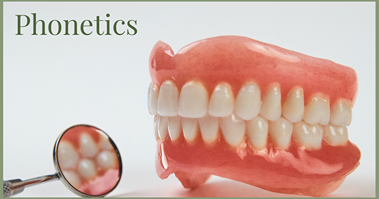
A major portion of speech articulation takes place within the oral cavity, so, complete dentures may alter the oral structures and inevitably mediate a disturbance in speech production. The disturbance may be minor or more substantial in importance, depending on individual responses.
Fortunately, the phonetic problems that arise when speaking with new dentures rarely pose serious difficulties and the initially experienced speech disturbances will be transient as most patients’ ability to adapt is good.
However, the treatment objective is to make complete dentures conform to the individual patient’s existing neuromuscular patterns, rather than rely too much on the patient’s ability to adapt.
Vowels
- a, e, i, o, u.
- Vowels are voiced sounds, that is, the vocal cords are activated by vibration in their production.
- They are the free emission of a speech sound through the mouth and require subglottic pressure for the production.
- Requires minimum articulation.
- Classified according to tongue position and lip position.
Consonants
-
Produced as a result of airstream being impeded, diverted or interrupted before it is released.
-
May be either:
- Voiced - vocal cords are activated by vibration in their production.
- Breathed - produced without vocal cord vibration.
Classification
Based on mode of production and use of different articulators and valves:
-
Plosive Consonants (p, t, k, b, d, g): Produced by stopping the airflow in the vocal tract and releasing the air in an explosive way.
**Plosives** **Breathed** **Voiced** Bilabial p (pay) b (bay) Linguoalveolar t (to) d (dot) Linguovelar k (back) g (bag) -
Fricatives/Sibilants (f, v, th, s, z, sh, h): Sharp and whistling sound quality, created when air is squeezed through the nearby obstructed articulators.
**Fricatives / Sibilants** **Breathed** Voiced Labiodental f (fan) v (van) Linguodental th (thumb) th (there) Linguoalveolar s (so) z (zoo) Linguopalatal sh (shoe) z (vision) Linguovelar h (who) -
Affricatives (ch, j): Mix between plosives and fricatives.
**Affricatives** **Breathed** **Voiced** Linguopalatal ch (chin) j (jar) -
Nasal Consonants (m, n, ng): Produced without oral exit of air.
**Nasal consonants** **Breathed** **Voiced** Bilabial m (man) Linguoalveolar n (name) Linguovelar ng (bang) -
Liquid Consonants (r): Produced without friction.
**Liquids** **Breathed** **Voiced** Linguopalatal r (rose) -
Glides (w, y):Characterized by generally changing articular shape.
**Glides** **Breathed** **Voiced** Bilabial w (witch) Linguopalatal y (you)
Valves Involved In Speech Production
Six different valves exist, of which five may be affected by teeth position.
Bilabial Sounds (b, p, m)
-
Made by contact of the lips.
-
Insufficient support of the lips by the teeth or the denture base can cause these sounds to be objective.
-
Affected by:
- Antero-posterior position of anterior teeth.
- Thickness of the labial flange.
- Incorrect Vertical Dimension of Occlusion(VDO) or teeth positioning hindering proper lip closure.
Labiodental Sounds (f, v)
-
Made between the upper incisors and the labiolingual center to the posterior third of the lower lip.
-
If upper anterior teeth are too short (set too high up) : ‘v’ sound will be more like an ‘f’.
-
If upper anterior teeth are too long (set too far down) : ‘f’ sounds more like a ‘v’.
-
Relationship of the incisal edges to the lower lip:
- The dentist should stand alongside the patient and look at the lower lip and the upper anterior teeth while these sounds are made.
- If upper anterior teeth touch labial side of the lower lip : upper teeth are too far forward, or lower anterior teeth are too far back in the mouth.
- If the lower lip drops away from the lower teeth during speech : the lower anterior teeth are most probably too far back in the mouth.
- If imprints of the labial surfaces of the lower anterior teeth are made in the mucous membrane of the lower lip or if the lower lip tends to raise the lower denture, the lower teeth are probably too far forward, and this means that the upper teeth also are too far forward.
- Upper anterior teeth contact lingual side of lower lip : upper anterior teeth are set too far back or lower anterior teeth are too far forward in relation to lower residual ridge.
Linguodental Sounds (th)
-
Made with the tip of the tongue extending slightly between the upper and lower anterior teeth.
-
Observe amount of tongue seen with the words this, that, these and those :
- If ~3mm of tip of the tongue is not visible, anterior teeth are probably too far forward (except in patient with Class II type 1), or there may be excessive vertical overlap (that does not allow sufficient space for the tongue to protrude between anterior teeth).
- If more than 6mm of the tongue extends out between the teeth, when the sounds are made, teeth are probably too far lingual.
Linguoalveolar Sounds (t, d, s, z, n, l)
-
Made with the valve formed by the contact of tip of the tongue with the most anterior part of the palate (the alveolus), or the lingual side of the anterior teeth.
-
The sibilants (sharp sounds) s, z, sh, ch, and j (with ch and j being affricatives) are alveolar sounds because the tongue and alveolus form the controlling valve.
-
Observe the relationship of the anterior teeth to each other when these sounds are produced:
- A phrase such as “I went to church to see the judge” will cause the patient to use these critical sounds, and the relative position of the incisal edges will provide a check on the total length of the upper and lower teeth (including their vertical overlap).
- The upper and lower anterior teeth should approach end to end but not touch.
- Failure to approach exactly end to end, error in amount of horizontal overlap of the anterior teeth (but not indicate whether it is the upper teeth or the lower teeth that are incorrect labiolingually).
-
The s sound (most interesting from the dental point of view):
- Its articulation is mainly influenced by the teeth and palatal part of the maxillary prosthesis.
- The tongue’s anterior dorsum forms a narrow groove near the midline with cross-section of about 10 sqmm, size and shape of this small space determine the quality of sound.
• If opening is too small, a whistle will result.
• If space is too broad and thin, s will be as sh sound. - Frequent cause of undesired whistles with dentures, too narrow posterior dental arch form.
Linguopalatal Sounds
The truly palatal sounds (e.g., those in year, she, vision, and onion) present less of a problem for dentures.
Linguovelar Sounds (k, g, ng)
- Have no effect on dentures, except when posterior palatal seal extension encroaches on the soft palate.
Points to Note
- It appears that adaptation to complete dentures may be explained by feedback mechanisms related to speech motor programming.
- Initially, the patient attempts to overcome problems related to the new prosthesis by the help of auditory and oro-sensory feedbacks during function.
- After a while, only the patient will be aware of remaining articulatory difficulties, which often are related to certain specific sounds. The listener (dentist) is, however, not able to detect any speech production disturbances. At this stage, there is still sensory stimulation from oro-facial afferents to central areas.
- Finally, if the process of adaptation proceeds, the patient will not be aware of any articulatory difficulties or distortional sounds caused by the prosthesis. New speech production central engrams have been established, and adaptation and habituation to the complete denture occur.
References
- Prosthodontic Treatment for Edentulous Patients - Complete Dentures and Implant-Supported Prostheses - Zarb, Hobkirk, Ekert, Jacob (13th Edition).
*This article is an excerpt from the above mentioned book and Medical Sutras does not make any ownership or affiliation claims.