
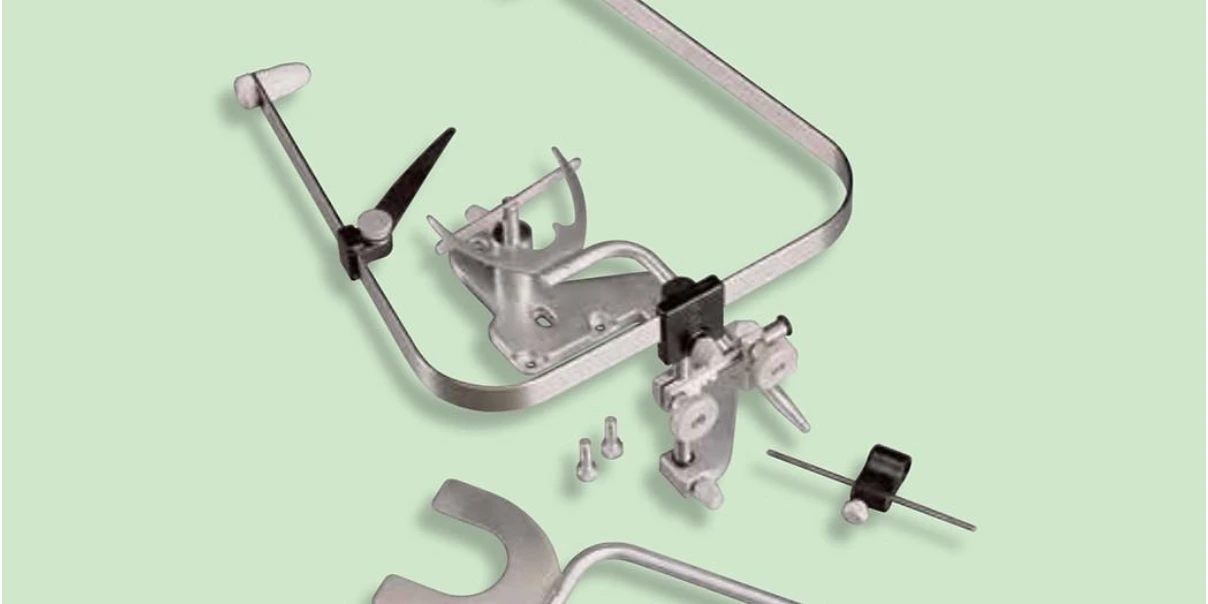
Facebow is a caliper-like instrument used to record the spatial relationship of the maxillary arch to some anatomic reference point or points and then transfer this relationship to an articulator.
It orients the dental cast in the same relationship to the opening axis of the articulator.
Customarily the anatomic references are the mandibular condyles, transverse horizontal axis, and one other selected anterior point.
(GPT-9)
According to Boucher, the facebow is a caliper like device that is used to record the relationship of the jaws to the opening axis and to orient the casts in the same relationship to the opening axis of the articulator.
Parts of Facebow
- Earpieces
- Orbital pointer
- U-shaped frame
- Bite fork
- Mounting jig
- Locking device
- Anterior elevator
- Transfer clamp assembly
Classification of Facebow
Facebows are classified as:
-
Arbitrary facebow
- Fascia type
- Earpiece type
-
Kinematic facebow (Hingebow)
Arbitrary Facebow
- It is placed with the condylar rods located approximately over the condyles.
- The fork is attached to the maxillary occlusal rim, a minimum error of 5mm from the axis can be expected.
Fascia type
- It utilises approximate points on the skin over the temporomandibular region as the posterior reference points.
- The points are located by measuring from certain anatomical landmarks on the face
Earpiece type
-
It uses the external auditory meatus as an arbitrary reference point (aligned with earpieces similar to those on a stethoscope).
-
Do not require measurements/works on the face.
-
Provides an average anatomic dimension between the external auditory meatus and horizontal axis of mandible.
-
It is simple to use and give sufficiently accurate relationship for most diagnostic and restorative procedures.
Advantages
- Helps in securing anteroposterior cast position with relation to the condyles of the mandible.
- Acts as an aid in the vertical positioning of the casts on the articulator.
- Registers the horizontal relationship of the casts quite accurately, and hence assists in correctly locating the incisal plane.
- Facebow transfer allows more accurate arc of closure on the articulator when the interocclusal records are removed and the articulator is closed.
- Essentially records the positional relation of the maxilla to the condyles in centric relation, and later transfers this relation to the articulator so that the maxillary cast is mounted in the same spatial relationship.