
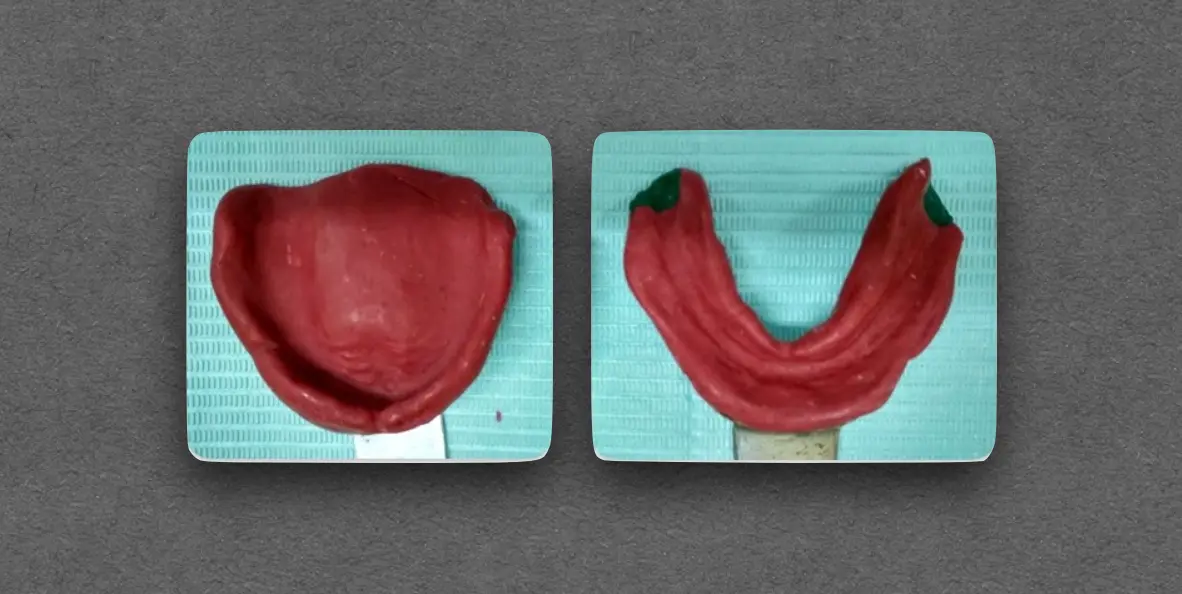
Most impression procedures involve making the preliminary impression in a stock tray. The preliminary impression should be as accurate as possible, so that, the custom tray can be fabricated properly with appropriate relief.
Trays
- Stock trays can be of either metal or plastic and may be perforated or unperforated.
- Selection : An edentulous stock tray that is approximately 5 mm larger than the outside surface of the residual ridge is selected.
- The tray should be placed by centering the labial notch of the tray over the labial frenum. In the maxilla, the distal extension should cover the vibrating line (allowing space and coverage of the tuberosities), while in the mandible, the tray should extend to the ascending ramus.
Impression Materials
An impression material with relatively high viscosity is recommended, as it allows the material to compensate easily for the deficiencies of the tray. The most suitable materials are alginate, silicone putty or impression compound.
Alginate
- Records the detail accurately and it is the most universally used impression material for primary impression.
- Can exhibit defects in the palatal area, as it does not absorb the mucous secretions from the palate.
- Must be poured immediately.
- The dental stone weight can distort impression borders, if they are not supported by the borders of the tray (can be extended by adding wax or compound to the stock tray borders).
- Peripheral areas such as disto-buccal region of the maxilla and mylohyoid fossa of the mandible can be captured using a high viscosity alginate.
Silicone putty
- Often records surface details poorly, because of high viscosity.
- However, the high viscosity allows the material to flow beyond the tray and compensate for any under-extension of the stock tray. Also, once set, it can support itself in this position.
- Can record undercuts with reasonable accuracy, as it exhibits some degree of elasticity.
Impression compound
- It is a thermoplastic material with high viscosity.
- Records the surface details poorly.
- Easily compensates for any under-extension and maintains the position after it is cooled. (Not necessary to correct any under-extension of the stock tray before using this material.)
- It is nonelastic and will cause trauma in severe boney undercuts (can be avoided by rotating from these anatomic areas, unless, they are sharp and bilateral).
- The impression can be removed from the tray, the borders trimmed and heated with a torch, and the periphery successively molded to the correct width and depth.
- Tissue undercuts and relief areas can be cut from the tissue surface of the tray.
- Also, if any part of the impression is deficient, stick compound can be added to the periphery in deficient areas.
Technique
-
Tray adhesive : Necessary when working with alginate and silicone putty. (Impression compound : Not required).
-
Tray border modification : Required in alginate impression making.
-
Preloading : Less viscous alginate may require preloading with injection or wiping of material into the floor of mouth or posterior buccal vestibules of the maxilla, to avoid voids and under-extended impression.
-
Maxillary tray placement
- The loaded tray is placed and rotated from one tuberosity. It is rotated from that lateral side to the other lateral side and tuberosity. (This decreases the risk of trapping air and allows the material to flow to the peripheries.)
- The denture is supported and the patient is asked to suck and pull the cheeks and lips down.
- The mandible is moved right and left to capture the coronoid space.
-
Mandibular tray placement
- The loaded tray is placed in the mouth with the tongue raised.
- It is slipped between the tongue and ridge and ask the patient to relax the tongue as the tray is seated.
- After seating the tray, the patient is asked to suck the lips inward, open the mouth wide, and protrude and move the tongue laterally.
References
- Prosthodontic Treatment for Edentulous Patients Complete Dentures and Implant-supported Prostheses (13th edition) , Zarb, Hobkirk, Eckert, Jacob, Mosby Elsevier.
*This article is an excerpt from the above mentioned book and Medical Sutras does not make any ownership and affiliation claims.