
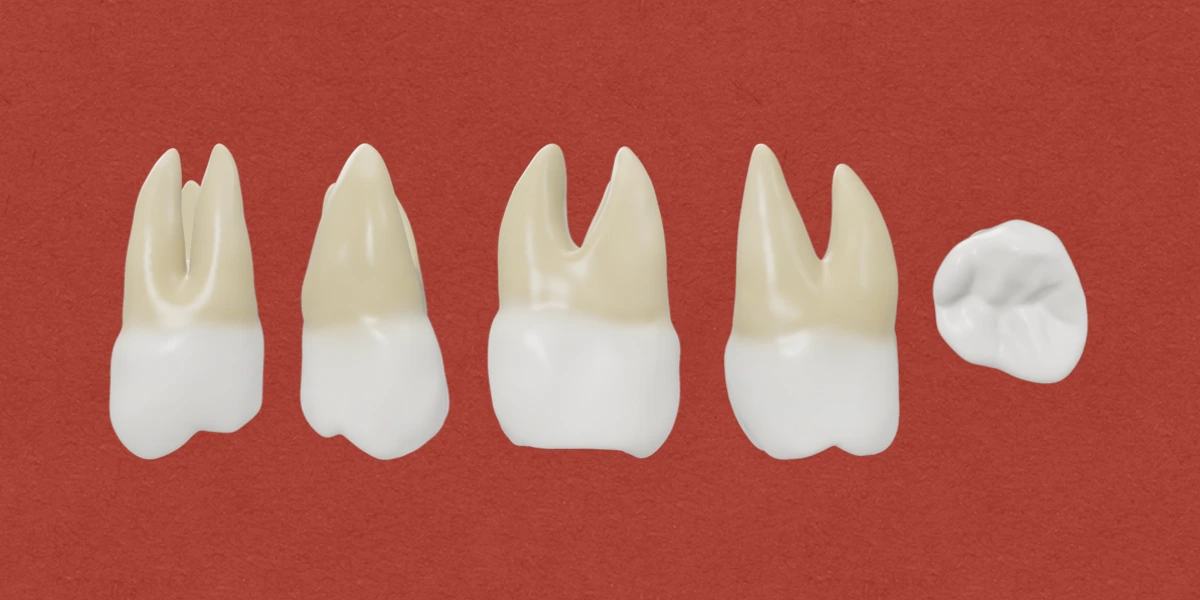
Permanent Maxillary Second Molar is the 7th tooth from midline, located posterior or distal to Permanent Maxillary First Molar and anterior or mesial to Permanent Maxillary Third Molar. It supplements the first molar in grinding of food and maintaining vertical dimensions of face.
The term molar is derived from the Latin word 'mola' which refers to millstone (a pair of large flat stones used for grinding food). In Latin the molar teeth are called 'Molaris dens' which means grinding teeth. So, the etymology is: Mola --> Molaris dens --> Molar teeth.
Tooth Numbering
- FDI system: 17 (Permanent Maxillary Right 2nd Molar), 27 (Permanent Maxillary Left 2nd Molar)
- Universal system: 2 (Permanent Maxillary Right 2nd Molar), 15 (Permanent Maxillary Left 2nd Molar)
- Zsigmondy-Palmer system: 7| (Permanent Maxillary Right 2nd Molar), |7 (Permanent Maxillary Left 2nd Molar)
Chronology
- First evidence of calcification: 2½ years
- Crown completion: 7-8 years
- Eruption: 12-13 years
- Root completion: 14-16 years
Dimensions
- Overall length: 18-19mm
- Crown length: 11mm
- Root length: 7mm (Buccal), 8mm (Lingual)
- Mesiodistal diameter of crown: 9mm
- Mesiodistal diameter of crown at cervix: 7mm
- Buccolingual diameter of crown: 11mm
- Buccolingual diameter of crown at cervix: 10mm
Surfaces, Lines Angles, Point Angles
- Surfaces (5): Buccal, Lingual, Mesial, Distal, Occlusal
- Line Angles (8): Mesiobuccal, Distobuccal, Mesiolingual, Distolingual, Mesioocclusal, Buccoocclusal, Distoocclusal, Linguoocclusal
- Point Angles (4): Mesiobuccoocclusal, Distobuccoocclusal, Distolinguoocclusal, Mesiolinguoocclusal
Tooth Morphology
Buccal Aspect
- Buccal surface: Smooth and convex, similar to that of Permanent Maxillary 1st Molar, but, the crown is shorter and narrower mesiodistally.
- Cusps: DB cusp is smaller and shorter than MB cusp, and a part of DL cusp and DMR is visible. The MB and DB cusps are separared by the buccal developmental groove.
- Mesial outline: Almost straight from the cervix to the mesial contact area (MCA), where it becomes convex and joins the mesial slope of MB cusp. The MCA is at the junction of occlusal and middle thirds of crown.
- Distal outline: Convex from the cervix to the point it joins the occlusal outline. The distal contact area is at the middle third tof the crown.
- Occlusal outline: Formed by the cusp tips and slopes/ridges of the buccal cusps. The occlusal outline appears to tilt cervically in distal direction as the Db cusp is smaller.
- Cervical outline: Nearly sttraight mesiodistally.
Lingual Aspect
-
Cusps: Mesiolingual and Distolingual cusps, separated by the lingual developmental groove.
-
Crown outlines: Similar to the outlines seen from the buccal aspect.
- Mesial: Almost straight with MCA at the junction of occclusal and middle thirds.
- Distal: Convex from cervix to occlusal outline, with DCA at the middle third.
- Cervical: Nearly straight.
- Occlusal: Formed by ML and DL cusp tips and their mesial and distal slopes/ridges.
-
Comparison with Permanent Maxillary 1st Molar:
- DL cusp is smaller
- DB cusp may be seen through the sulcus between ML and DL cusps
- 5th cusp is not present Mesial Aspect
-
Surface: Smooth and convex.
-
Cusps: Mesiobuccal and Mesiolingual cusps, almost of same length.
-
Buccal outline: More convex in the cervical thirs and less convex occlusaly. Height of contour is in the cervical third.
-
Lingual outline: Convex from the cervix to the ML cusp tip. Height of contour is at the middle third.
-
Cervical outline: Almost a straight line buccolingually.
-
Occlusal outline: Presents a smooth concave arc formed by the Mesial Marginal Ridge (MMR), that joins the mesial cusp ridges of MB and ML cusps.
-
Comparison with Permanent Maxillary 1st Molar:
- BL dimension is about the same, but crown length is less
Distal Aspect
- Surface: Narrower and shorter the mesial surface. Hence, some part of buccal surface and MB cusp is visible.
- Crown outlines: Similar to mesial aspect
- Buccal: More convex in cervical third and less convex occlusally. Height of contour is in cervical third.
- Lingual: Uniform convexity from cervix to DL cusp. Height of contour at the middle third.
- Cervical: Nearly straight
- Occlusal: Formed by DB and DL cusps, and Distal Marginal Ridge (DMR). The DMR is irregular and at a lower level than MMR.
Occlusal Aspect
-
Shape: The tooth may appear rhomboidal in shape resembling Permanent Maxillary 2nd Molar (more common), or it may be heart-shaped similar to the Permanent Maxillary Third Molar.
-
Dimensions
- BL dimension is more than MD dimension.
- Crown tapers towards the distal surface, so, the BL measurement is greater mesially than distally.
-
Elevations
- Cusps (4): ML > MB > DB > DL. The DL cusp appears separated from the rest of the occlusal surface.
- Cusp ridges: Each cusp presents mesial and distal cusp ridges on either side, and a triangular ridge towards the center.
- Marginal ridges: Mesial and Distal marginal ridges, forms the mesial and distal boundary of the occlusal surface respectively.
- Oblique ridge: Connects triangular ridge of DB cusp and distal ridge of ML cusp.
-
Depressions
-
Pits (3): Central Pit, Mesial Pit, Distal Pit
-
Fossae (4): 2 major fossae (Central fossa and Distal fossa), 2 minor fossae (mesial and distal triangular fossa)
-
Developmental grooves (3): Originates from the central fossa
- Buccal developmental groove: Extends onto the buccal surface between the two buccal cusps
- Central developmental groove: Runs in the mesial direction
- Transverse groove of oblique ridge: Runs in DL direction, crossing the oblique ridge.
-
Supplemental grooves: Radiatesfrom the mesial and distal pits into the mesial and distal triangular fossae.
-
References
- Wheeler's Dental Anatomy, Physiology and Occlusion, Stanley J. Nelson DDS MS, Elsevier
- Textbook Of Dental Anatomy, Physiology & Occlusion, Rashmi GS Phulari, Jaypee Brothers Medical Publishers Pvt Ltd
*This article is excerpt from the above mentioned sources and Medical Sutras does not make any ownership and affiliation claims.