
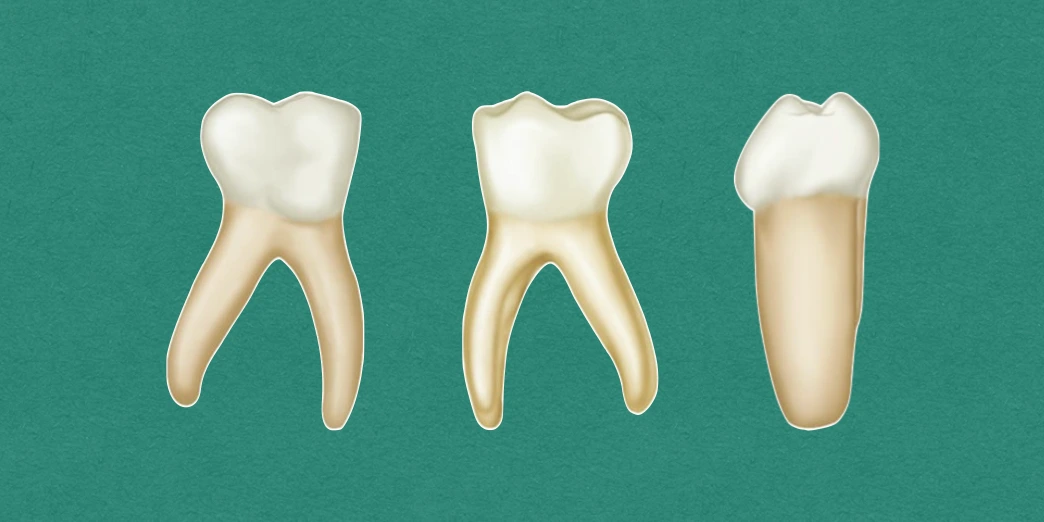
The primary mandibular first molar appears strange and primitive, as it does not resemble any other primary or permanent teeth.
This is particularly emphasised from the buccal aspect of the tooth. A line drawn from the bifurcation of the roots to the occlusal surface, evenly divides the tooth mesiodistally. Two complete teeth are represented, however, the mesial portion crown is almost twice as tall as the distal half, and the root is a third longer than the distal one.
Chronology
- First evidence of calcification: 151/2 weeks in utero.
- Crown completion: 51/2 months.
- Eruption: 16 months.
- Root completion: 21/4 years.
Dimensions
- Overall length: 15.8 mm.
- Crown length: 6.0 mm.
- Root length: 9.8 mm.
- Mesiodistal diameter of crown: 7.7 mm.
- Mesiodistal diameter of crown at cervix: 6.5 mm.
- Labiolingual diameter of crown: 7.0 mm.
- Labiolingual diameter of crown at cervix: 5.3 mm.
Crown Morphology
Buccal Aspect
- Mesial outline is almost straight from the contact area to the cervix, with very little constriction at the cervix.
- Distal outline converges toward the cervix more than usual, so that the contact area extends distally to a marked degree.
- Distal portion of the crown is shorter than the mesial portion, and the cervical line dips apically where it joins the mesial root.
- The buccal cusps are distinct,and the mesial cusp is larger than the distal cusp.
- Although development groove is not evident between the two buccal cusps, a developmental depression extends over the buccal surface, and divide the cusps.
Lingual Aspect
- The crown length is more uniform mesially and distally, and the cervical line is straighter.
- On the mesial surface, the crown and root converge lingually to a marked degree, while, the opposite is true for distal surface.
- Mesiolingual cusp is long and sharp at the tip (more than any other cusps), while, the distolingual cusp is rounded.
- Mesial marginal ridge is well developed and might almost be considered as a small cusp.
Mesial Aspect
- The crown outline resembles the mesial aspect of the primary second molar and permanent lower molars, except for the extreme buccal curvature at the cervical third. This is the most noticeable detail from the mesial aspect.
- Buccal outline of the crown from the crest of curvature of the buccal surface at the cervical third to the tip of the MB cusp is flat. All primary molars have flattened buccal surfaces above this cervical ridge.
- The buccal cusps are placed over the root base.
- The lingual outline extends out lingually beyond the confines of the root base.
- The cervical line slants upward buccolingually, since the MB crown length is greater than the ML crown length.
Distal Aspect
- Buccal and lingual length of crown is more uniform.
- Cervical line does not drop buccally, and extends almost straight buccolingually.
- DB and DL cusps are not as long and sharp as the two mesial cusps.
- Distal marginal ridge is not as straight or well defined as the mesial marginal ridge.
Occlusal Aspect
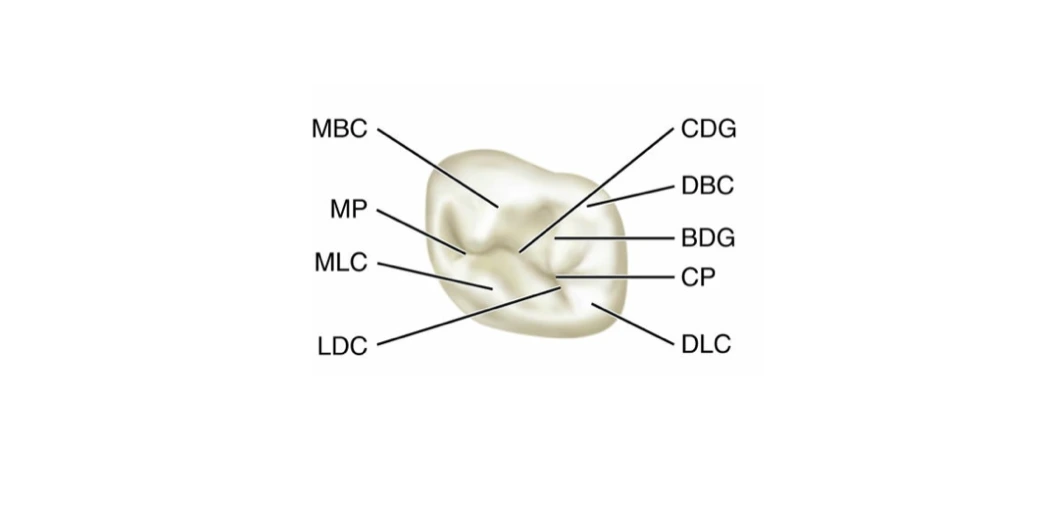
- The general outline is rhomboidal.
- Mesiobuccal prominence accents the MB line angle in comparison to the DB line angle, thereby emphasising the rhomboidal form.
- Mesiolingual cusp has a broad, flattened surface lingually, and is seen as the largest and best developed of all the cusps.
- Buccal developmental groove is short, and extends from between the buccal cusp ridges to a point approximately in the center of the crown at a central pit. It divides the two buccal cusps evenly.
- Central developmental groove joins buccal developmental groove at the central pit, and extends mesially, ending in a mesial pit in the mesial triangular fossa. It separates the MB and ML cusps.
- The central groove is joined by two supplemental grooves in the center of the mesial triangular fossa: one extends buccally, while other extends lingually.
- Mesiobuccal groove presents a well defined triangular ridge that terminates at the central developmental groove.
- Lingual developmental groove extends lingually, and separates the ML and DL cusps. It stops at the junction of lingual cusp ridges.
Root Morphology
Buccal Aspect
- Roots are long and slender, and spread greatly at the apical third beyond the crown outline.
Mesial Aspect
- The mesial root outline does not resemble the outline of any other primary tooth root.
- The buccal and lingual outlines drop straight down from the crown and are approximately parallel for more than half their length, tapering only slightly at the apical third.
- The root end is flat and almost square.
- A developmental depression usually extends almost the full length of the root.
Distal Aspect
- Distal root is rounder and shorter, and tapers more apically.
References
- Wheeler's Dental Anatomy, Physiology and Occlusion(2019), Stanley J. Nelson DDS MS, Elsevier.
*This article is excerpt from the above mentioned book and Medical Sutras does not make any ownership and affiliation claims.